Empowering Young Minds: Top 10 Programming Schools for Children in Nigeria - A Parent Guide
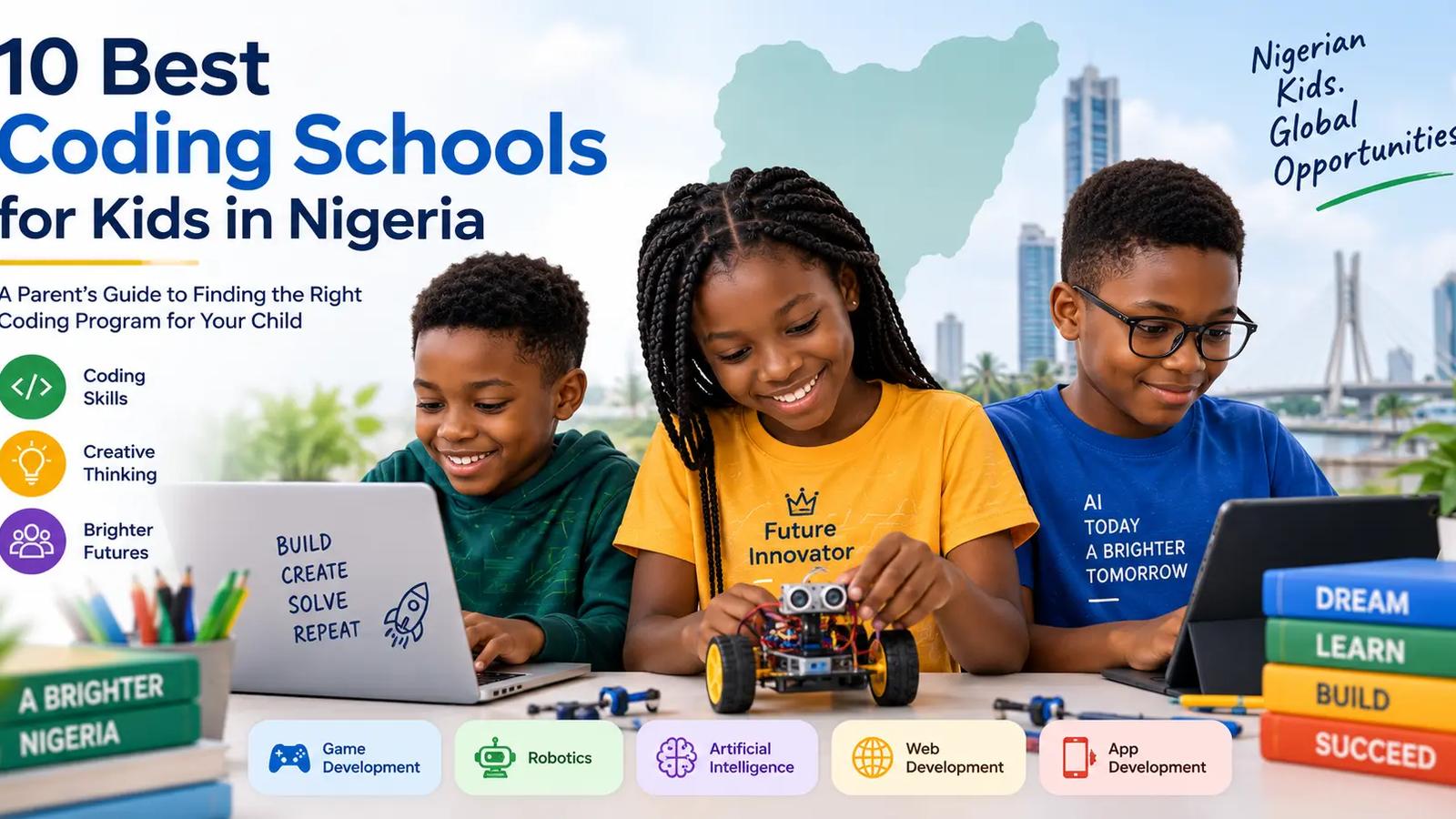
Finding the right coding school for your child can be difficult.
A search for coding classes for kids in Nigeria now brings up programmes covering Scratch, Python, robotics, artificial intelligence, game development, web development and more. Some are fully online, some teach physically, and others combine both formats.
The bigger question for parents is therefore no longer simply:
"Where can my child learn coding?"
It is:
"Which coding school is actually right for my child?"
A good children's coding programme should do more than teach a child how to follow programming instructions. It should help learners understand how technology works, develop problem-solving skills and gradually become capable of building their own projects.
This guide compares coding schools serving children in Nigeria and explains what parents should look for before enrolling.
Quick Answer: What Are Some of the Best Coding Schools for Kids in Nigeria?
Parents looking for coding schools in Nigeria can consider programmes such as Imagine STEM Academy, earlySTEMer, TechQuest STEM Academy, Codingal and other specialist children's technology academies. The right choice depends on your child's age, interests, learning needs, preferred class format and the quality of the programme's curriculum and instruction.
Before choosing any provider, compare its current course offerings, class format, instructor support, project work, learner progression and parent communication.
What Should Parents Look for in a Coding School?
A recognisable brand does not automatically mean a programme is right for your child.
Before comparing individual schools, use these criteria.
1. Age-appropriate curriculum
A six-year-old and a sixteen-year-old should not be learning programming in the same way.
Younger beginners generally benefit from visual environments and creative activities, while older or more experienced learners can progress into text-based programming and specialised technology fields.
A reasonable progression could look like:
Age
5–8
Possible Starting Areas
Scratch, visual coding, digital creativity
Example Projects
Stories, animations and simple games
Age
9–12
Possible Starting Areas
Scratch, Python basics, robotics, beginner AI
Example Projects
Games, simple programs and robotics projects
Age
13–19
Possible Starting Areas
Python, web development, app development, AI
Example Projects
Websites, applications and portfolio projects
Age alone should not determine placement. Previous experience, interests and learning readiness also matter.
2. Project-based learning
Children should build.
A programming programme consisting mainly of lectures and demonstrations misses one of the greatest advantages of learning to code.
Look for opportunities to create games, websites, applications, animations, robots or other tangible projects.
3. Instructor interaction
Children frequently get stuck while programming.
An instructor should be able to identify misconceptions, ask questions, provide hints and help the learner understand why something is not working rather than simply supplying the answer.
4. Clear progression
Ask what happens after the beginner programme.
A strong academy should be able to explain how a learner progresses from foundational concepts into more advanced skills.
5. Parent visibility
Parents should have some way of understanding what their child is learning.
Depending on the provider, this might include progress reports, assessments, project showcases, instructor feedback or parent dashboards.
6. Learning environment and accessibility
Class size, teaching pace and instructor support matter, particularly for younger learners and children who need additional learning support.
7. Online, physical or hybrid delivery
There is no universally superior option.
Online classes provide convenience and access from almost anywhere, while physical classes provide face-to-face interaction. Hybrid providers give families more flexibility.
Choose based on how your child learns best.
10 Coding Schools for Kids in Nigeria to Consider
This list is intended as a starting point rather than an absolute ranking. Programmes, prices, locations and course availability change, so parents should verify current details directly with each provider before enrolling.
1. Imagine STEM Academy
Imagine STEM Academy provides live technology education for children and teenagers through project-based programmes covering coding and broader digital skills.
ISA's learning pathways are designed around different stages of childhood rather than treating children's programming as a single course.
Learners can explore areas including:
- Scratch programming
- Python
- Website development
- Artificial intelligence
- Robotics
- Game development
- App development
- Creative technology skills
A significant feature of the ISA model is its emphasis on live instruction and project creation. Children are expected to apply concepts by creating things rather than only watching recorded lessons.
ISA also supports different learning needs and recognises that children do not all progress at the same speed.
Who is Imagine STEM Academy suitable for?
ISA is particularly relevant for parents looking for:
- Live instructor-led classes
- Online or physical learning options
- A structured long-term learning pathway
- Project-based STEM education
- Small learning groups
- Progress feedback for parents
- Coding alongside AI, robotics and creative technology
- Learning support that considers individual learner needs
Children can begin with an introductory trial or assessment before moving into an appropriate learning pathway.
Best suited to: Families looking for a structured, instructor-led coding and STEM pathway rather than a single short coding course.
Explore: Coding Classes for Kids | Scratch | Python | AI | Robotics | Trial Class
Start Your Kids Trial esson
2. earlySTEMer
earlySTEMer provides coding programmes for children and teenagers and is based in Lagos while serving learners online.
Its current virtual programme advertises small-group classes and courses covering areas such as Scratch, HTML, Python and app development. The provider also offers seasonal programmes and other learning formats.
Best suited to: Parents specifically interested in small-group virtual coding programmes.
3. TechQuest STEM Academy
TechQuest is known in Nigeria's STEM education ecosystem for exposing young learners to technology and problem-solving.
Its programmes have historically included areas such as coding, robotics and digital skills.
Parents considering TechQuest should check its current children's programmes, locations and enrolment schedules before making a decision.
Best suited to: Families looking for broader STEM exposure alongside programming.
4. Codingal
Codingal is an international online coding education provider that also markets programmes specifically to families in Lagos.
Its current Lagos offering covers Scratch, Python, AI, app development and other programming pathways, with live online instruction and small-group formats.
Unlike a locally physical academy, Codingal's core proposition is online learning.
Best suited to: Families looking for a large international online coding platform with structured programmes.
5. CodeReality STEM Academy
CodeReality STEM Academy is a Lagos-based children's STEM provider.
Its current course catalogue includes Scratch, PictoBlox, Unity 3D and other technology subjects.
The breadth of its catalogue may appeal to children who want to explore different areas of technology beyond an introductory programming course.
Best suited to: Lagos families looking for exposure to multiple coding and technology tools.
6. STEMulus KidsTech
STEMulus KidsTech provides live online programming classes for children and teenagers.
Its current offering includes Scratch, Python, web development, robotics, creative coding and AI-related programmes, with a strong emphasis on personalised online instruction.
Best suited to: Families seeking personalised live online lessons, including Nigerian families living abroad.
7. InstinctHub Kids Can Code
InstinctHub Kids Can Code offers a structured children's programming programme for learners aged 7–18.
Its current programme places particular emphasis on Python, projects and progression through defined learning stages, with physical learning in Ikoyi alongside virtual participation.
Best suited to: Children ready to work with text-based programming and families interested in a clearly staged Python pathway.
8. Kishron Innovation Hub
Kishron Innovation Hub provides coding education for children aged 5–16.
Its current curriculum progresses from ScratchJr and Scratch into Python, web development, game development, app development, AI and physical computing. It also advertises in-person, school-partnership, self-paced and seasonal learning options.
Best suited to: Parents looking for age-based progression across several technology disciplines.
9. Thynkcity
Thynkcity provides technology education across children, teenagers and adults.
Its children's programmes currently include robotics, Scratch, Python and AI, while its teenage offerings extend into web development and more advanced technology subjects.
Best suited to: Families interested in coding alongside hands-on robotics and broader technology education.
10. Spraditech Digital Solutions
Spraditech Digital Solutions includes a dedicated technology programme for children among its wider technology training offerings.
Its children's programme currently introduces Scratch, robotics and creative problem-solving, with in-person, live-online and self-paced options advertised.
Best suited to: Parents who want multiple delivery formats and an introductory combination of coding and robotics.
How to Compare Coding Schools Before Paying
Do not choose purely from a "Top 10" list, including this one.
Shortlist two or three providers and ask each of them essentially the same questions:
- What programme would you recommend for my child's age and current experience?
- What will my child actually be able to build?
- How many learners are normally in a class?
- Who teaches the classes?
- How is progress assessed?
- What happens when my child struggles?
- Can parents see progress or receive instructor feedback?
- What programme comes next after this one?
- Can my child attend a trial or assessment first?
- What equipment and software will we need?
The answers are more useful than marketing claims such as "world-class", "future-ready" or "best coding school."
Online vs Physical Coding Schools in Nigeria
Both can work.
Choose online learning when your child can concentrate independently on a computer, you want access to instructors regardless of location, or commuting to a physical academy would be difficult.
Choose physical learning when your child benefits substantially from face-to-face interaction, hands-on equipment or an in-person classroom environment.
Hybrid programmes can be useful for families that want both.
The quality of teaching matters more than whether the lesson happens through a screen or inside a classroom.
Scratch, Python, Robotics or AI: Where Should Your Child Begin?
The most advanced subject is not necessarily the best starting point.
For a young beginner, Scratch can provide an accessible introduction to sequencing, loops, conditions, variables and problem-solving.
A learner who has developed these foundations can progress into Python and other text-based programming.
Children particularly interested in building physical objects may enjoy robotics.
Artificial intelligence can then be introduced in an age-appropriate way alongside foundational programming, responsible AI use and critical thinking.
For a deeper explanation, read our guide on how to start teaching your child coding at home.
How Much Should Coding Classes for Kids Cost in Nigeria?
Prices vary considerably based on:
- Group versus private instruction
- Online versus physical delivery
- Programme length
- Number of lessons
- Instructor experience
- Equipment requirements
- Class size
- Curriculum depth
Parents should therefore compare value, not simply the cheapest monthly fee.
A less expensive programme that mainly provides videos may offer less direct support than a live programme with projects, instructor feedback and progress reporting.
Always confirm current pricing directly with the provider.
What Makes a Good Children's Coding Programme?
A strong programme should gradually move a child through three stages:
Learn → Build → Explain
First, the child learns a concept.
Then they use it to build something.
Finally, they should be able to explain what they created and how it works.
That final stage matters.
A child who can explain why a loop was used or how a variable controls the score demonstrates much deeper understanding than one who simply copied code from a tutorial.
Which Coding School Is Best for Your Child?
There is no single coding school that will be best for every child in Nigeria.
A six-year-old discovering Scratch needs something different from a sixteen-year-old building a Python portfolio.
Instead of asking only:
"Which is the best coding school?"
Ask:
"Which programme provides the best learning environment for my child at their current stage?"
Consider age, interests, learning needs, instructor quality, class size, curriculum, project opportunities, progression and parent feedback.
For families considering Imagine STEM Academy, the easiest starting point is a trial class. This allows the learner's interests and current ability to be considered before choosing a programme.
Explore Coding Classes for Kids
Frequently Asked Questions
What is the best coding school for kids in Nigeria?
There is no single provider that is best for every learner. Compare programmes based on your child's age, experience, interests, class size, instructor support, project work and learning format.
What age can a child start learning coding?
Children can begin age-appropriate computational thinking and visual programming activities from around age five. Scratch and similar visual tools are commonly used with younger learners before progression into text-based languages.
Which programming language should children learn first?
Younger beginners often benefit from visual programming such as Scratch. Older learners or children with existing foundations can progress into Python, JavaScript and web technologies.
Can children learn coding online?
Yes. Live online coding classes can be effective when they include instructor interaction, practical projects, appropriate class sizes and opportunities for feedback.
Is Scratch or Python better for children?
Neither is universally better. Scratch makes programming logic easier to visualise and is particularly suitable for beginners. Python introduces text-based programming and is appropriate once learners are ready for greater complexity.
Should children learn AI?
Children can learn age-appropriate AI concepts, but AI education should include critical thinking, responsible use and an understanding of underlying computational concepts rather than simply teaching children to generate answers with AI tools.
How do I know whether a coding school is good?
Ask to see its curriculum, example student projects, class structure, progression pathway and assessment approach. A trial lesson can also reveal considerably more than a website.